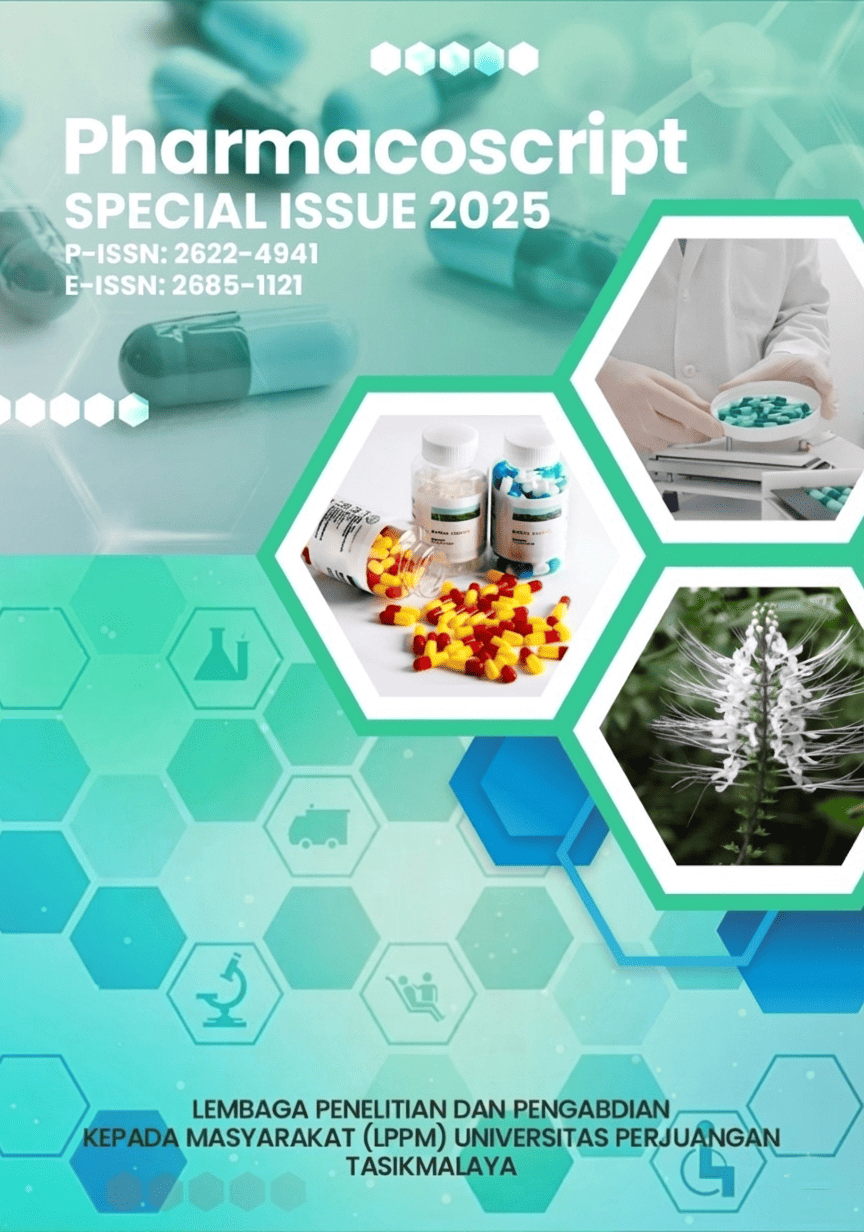
PENILAIAN POTENSI ANTIOKSIDAN DAN ANTIBAKTERI DISERTAI PENETAPAN KADAR KOMPONEN BIOAKTIF EKSTRAK DAUN DAN BUNGA Lavandula angustifolia
DOI:
https://doi.org/10.36423/pharmacoscript.v1iSpecial.2486Keywords:
Antibakteri, Antioksidan, Fenol, Flavonoid, LavenderAbstract
Lavender (Lavandula angustifolia) dikenal luas sebagai tanaman aromatik yang memiliki berbagai khasiat farmakologis, terutama sebagai antioksidan, antibakteri, dan agen pencerah kulit alami. Seiring meningkatnya permintaan konsumen terhadap produk perawatan kulit berbahan dasar alami, lavender memiliki komponen utama yaitu linalool asetat, senyawa yang berfungsi untuk membantu relaksasi sistem saraf serta melemaskan otot-otot yang tegang, dan flavonoid yang terbukti mampu menangkal radikal bebas, menghambat pertumbuhan bakteri penyebab jerawat, serta menghambat aktivitas enzim tirosinase yang berperan dalam pembentukan melanin. Radikal bebas diketahui sebagai pemicu stres oksidatif yang merusak sel kulit dan mempercepat penuaan dini. Tujuan dari penelitian ini adalah untuk mengukur kemampuan antioksidan sampel menggunakan dua pendekatan, yaitu metode DPPH dan metode CUPRAC juga menetapkan kandungan senyawa aktif sampel dan menguji aktivitas antibakteri menggunakan metode KHM dan KBM. Hasil yang didapatkan dari aktivitas antioksidan tertinggi dengan metode DPPH dan CUPRAC terdapat pada ekstrak n-Heksan daun sebesar 18,39 ± 0,01 dan 29,75 ± 0,02 dengan kadar flavonoid total tertinggi sebesar 6,52 ± 0,03 dan kadar fenolat total sebesar 11,51 ± 0,05. Aktivitas antibakteri paling signifikan diamati pada ekstrak metanol bunga lavender, dengan diameter zona hambat terhadap Escherichia coli sebesar 12,61 mm dan terhadap Staphylococcus aureus sebesar 14,00 mm pada konsentrasi 10%.
References
Aminah, Hamsinah, Adriana, N.F.M. (2023). AKTIVITAS ANTIOKSIDAN EKSTRAK DAUN PORANG (Amorpophallus muelleri Blume) SECARA SPEKTROFOTOMETRI UV-Vis. Makassar Natural Product Journal, 6(17), 164-175.
Apak, R., Gorinstein, S., Böhm, V. K. dan Schaich, M. K., (2013) ‘Methods of Measurement and Evaluation of Natural Antioxidant Activity’, IUPAC technical report, Pure Appl Chem 85: 957–998.
Arliandini, R., Mahdi, N., & Agustina, A. (2023). Uji Aktivitas Antibakteri Ekstrak Etanol Daun Benalu Batu (Begonia sp) Terhadap Bakteri Staphylococcus aureus dan Escherichia coli. Jurnal Insan Farmasi Indonesia, 6(2), 270–279. https://doi.org/10.36387/jifi.v6i2.1578
Chang, C., Yang, M., Wen, H. dan Chern, J. (2002), Estimation of Total Flavonoid Content in Propolis by Two Complementary Colorimetric Methods’, J Food Drug Anal, 10(3), 178-182.
Dobros, N.; Zawada, K.D.; Paradowska, K. (2023), Phytochemical Profiling, Antioxidant and Anti-Inflammatory Activity of Plants Belonging to the Lavandula Genus. Molecules, 28, 256. https:// doi.org/10.3390/molecules28010256
Endah kartikawati, Syumillah Saepudin, W. H. (2024). Uji Aktivitas Antibakteri Dan Analisis KLT-Bioautografi Ekstrak Etanol Daun Situduh Langit (Erigeron Sumatrensis Retz) Terhadap Bakteri Escherichia Coli. Jurnal Medika Farmaka 2 (1):165-75. https://doi.org/10.33482/jmedfarm.v2i1.31.
Esmael, A. et al (2020), Antimicrobial Activity of Certain Natural-Based Plant Oils Against the Antibiotic-Resistant Acne Bacteria’, Saudi Journal of Biological Sciences, 27(1), 448-455. https://doi.org/10.1016/j.sjbs.2019.11.006
Gaber, E.B., John, O.T., Lamiaa, W., Hazem, M.S., Ayomide, P.A., Titilade, K.A.T., Hayder, M.A., Ali, I., Athanasios, A., Matios, P. (2023). A Review of The Bioactive Components and Pharmacological Properties of Lavandula Species. Naunyn-Schmiedeberg's Archives of Pharmacology. 396(4):1-24. https://doi.org/10.1007/s00210-023-02392-x
Handayani, A., Putri, D. W., & Susanti, R. (2018). Aktivitas antioksidan ekstrak etanol daun binahong (Anredera cordifolia) dengan metode DPPH. Jurnal Ilmu Farmasi dan Obat Tradisional, 5(2), 101–107.
Downloads
Published
Issue
Section
License
Copyright (c) 2025 Fajarwati Kania, Roni Asep

This work is licensed under a Creative Commons Attribution-ShareAlike 4.0 International License.
Authors who publish with this journal agree to the following terms:
- Authors retain copyright and grant the journal right of first publication, with the work [SPECIFY PERIOD OF TIME] after publication simultaneously licensed under a Creative Commons Attribution License that allows others to share the work with an acknowledgement of the work's authorship and initial publication in this journal.
- Authors are able to enter into separate, additional contractual arrangements for the non-exclusive distribution of the journal's published version of the work (e.g., post it to an institutional repository or publish it in a book), with an acknowledgement of its initial publication in this journal.
- Authors are permitted and encouraged to post their work online (e.g., in institutional repositories or on their website) prior to and during the submission process, as it can lead to productive exchanges, as well as earlier and greater citation of published work (See The Effect of Open Access).








 This Journal is licensed under a