Peer Review Process
HEXAGRO applies a double-blind peer-review process: reviewers do not know the identity of the authors, and authors do not know the identity of the reviewers. Every research and review article is evaluated by at least two independent reviewers with expertise in the subject.
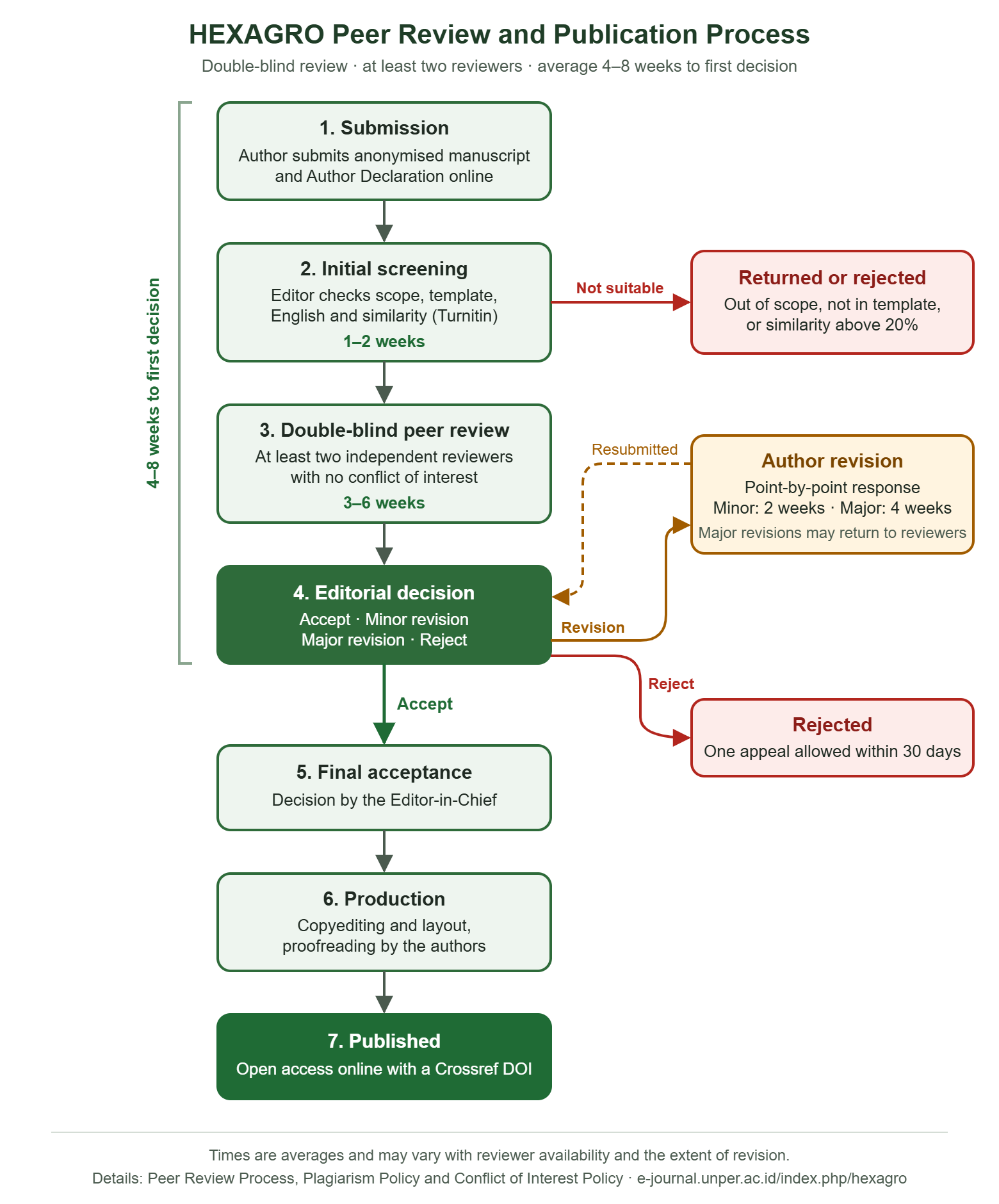
Figure: HEXAGRO peer review and publication process (click to enlarge).
- Submission. Authors submit the manuscript through the journal's online system, together with the anonymised manuscript file and the Author Declaration.
- Initial screening (1–2 weeks). The editor checks scope, compliance with the Author Guidelines and the article template, English quality, and similarity. Manuscripts with a similarity index above 20% or outside the scope are returned or rejected at this stage.
- Peer review (3–6 weeks). The handling editor assigns at least two reviewers who have no conflict of interest with the authors. Reviewers assess originality, scientific contribution, methodology, analysis, discussion, and the currency and relevance of references, using the journal's review form.
- Editorial decision. Based on the reviewers' reports, the editor makes one of four decisions: Accept, Minor Revision, Major Revision, or Reject. When reviewers disagree, the editor may invite a third reviewer.
- Revision. Authors return the revised manuscript with a point-by-point response to the reviewers within 2 weeks for minor and 4 weeks for major revisions. Major revisions may be sent back to the reviewers.
- Final decision. The Editor-in-Chief makes the final acceptance decision. Accepted manuscripts proceed to copyediting, layout, and proofreading by the authors before publication.
The average time from submission to first decision is 4–8 weeks. Manuscripts submitted by members of the editorial board are handled by another editor and follow the same double-blind process (see the Conflict of Interest Policy). Reviewers' identities and reports are kept confidential.