
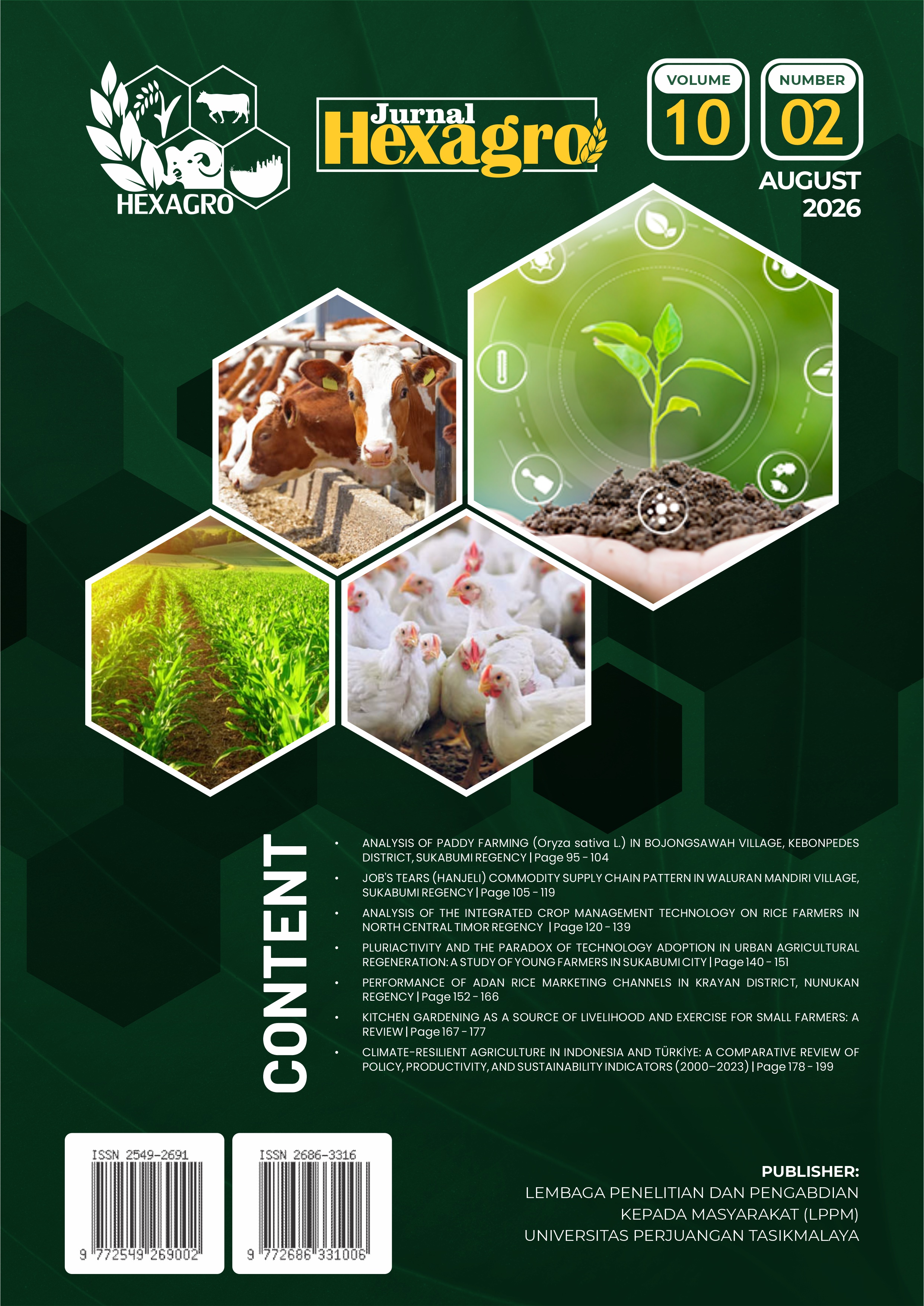
ANALYSIS OF THE INTEGRATED CROP MANAGEMENT TECHNOLOGY ON RICE FARMERS IN NORTH CENTRAL TIMOR REGENCY
A Case Study of Rice Farmers in Biboki Anleu District
DOI:
https://doi.org/10.36423/hexagro.v10i2.2701Abstrak
This study examines the adoption and implementation of Integrated Crop Management (ICM) technology on the Rice Field in Biboki Anleu Subdistrict, North Central Timor Regency. ICM is an approach that integrates various agricultural practices to enhance yields and sustainability, making it highly relevant in addressing food security challenges. The study was conducted from March to April 2025 in Biboki Anleu Subdistrict, North Central Timor Regency. The method used to measure the level of adoption of Integrated Crop Management technology was the Sturges formula. The study results show that the overall level of adoption or application of Integrated Crop Management technology by farmers is in the high category, at 74%. However, there were significant constraints in the application of ICM in Biboki Anleu Subdistrict, including: (a) the jajar legowo planting system having a very low level of application, (b) the recommended irrigation system being in the very low category, as farmers primarily still rely on rainwater and limited irrigation debit, and (c) the implementation of Integrated Pest Management (IPM) being in the very low category because all farmers protect their crops from pests and diseases using instant methods, namely chemical pesticides.
Unduhan
Diterbitkan
Cara Mengutip
Terbitan
Bagian
Lisensi
Hak Cipta (c) 2026 Jurnal Hexagro

Artikel ini berlisensiCreative Commons Attribution-ShareAlike 4.0 International License.
- Seluruh materi yang terdapat dalam situs ini dilindungi oleh undang-undang. Dilarang mengutip sebagian atau seluruh isi situs web ini untuk keperluan komersil tanpa persetujuan dewan penyunting jurnal ini.
- Apabila anda menemukan satu atau beberapa artikel yang terdapat dalam Jurnal HEXAGRO yang melanggar atau berpotensi melanggar hak cipta yang anda miliki, silahkan laporkan kepada kami, melalui email.
- Aspek legal formal terhadap akses setiap informasi dan artikel yang tercantum dalam situs jurnal ini mengacu pada ketentuan lisensi Creative Commons Attribution-ShareAlike (CC BY-SA).
- Semua Informasi yang terdapat di HEXAGRO bersifat akademik. Jurnal HEXAGRO tidak bertanggung jawab terhadap kerugian yang terjadi karana penyalah gunaan informasi dari situs ini.